Health & Safety Policy — Flat Clearance Wanstead
 Introduction: This Health and Safety policy sets out the commitment of our flat clearance operation to manage risks associated with rubbish removal, waste removal and flat rubbish clearance activities. It applies to all staff and contractors engaged in flat clearance and related waste services. Our aim is to protect employees, residents, visitors and the general public while delivering efficient rubbish collection and house clearance services across our service area. We recognise that safe working practices are fundamental to an effective rubbish company and accept responsibility for ensuring compliance with applicable health and safety requirements.
Scope and Legal Duties
All clearances, including house clearance, flat clearance and specialist waste removal, are carried out under a clear system of management. The organisation will assess risks, provide training, and ensure that personnel are competent to carry out their tasks. Responsibilities for safety are defined at all levels: managers oversee policy and compliance, supervisors ensure safe systems are followed day to day, and operatives follow guidance and report hazards. Legal obligations are observed and kept under review to maintain alignment with relevant health and safety legislation while minimising unnecessary local references.
 Risk assessment and control measures are central to our approach. We will identify hazards such as manual handling of bulky items, sharp objects in rubbish, hazardous household waste, potential asbestos-containing materials, and traffic risks at collection points. Risk control follows the hierarchy: elimination, substitution, engineering controls, administrative controls and personal protective equipment (PPE). A documented risk assessment is completed before complex clearances and is updated where conditions change.
Roles, Training and Competence
Staff engaged in flat clearance and rubbish removal services must be trained and assessed as competent. Training covers safe lifting techniques, correct use of equipment (trolleys, sack barrows, compactors and vehicles), manual handling, awareness of hazardous waste, and infection control when dealing with soiled items. Supervisors ensure refresher training and toolbox talks address operational hazards. Records of training and competence are maintained and reviewed periodically.
 Personal protective equipment is provided appropriate to the task: gloves, high-visibility clothing, steel-toe boots, eye protection and respiratory protection where dust, mould or asbestos risk is present. PPE is maintained and replaced as needed. Operatives must wear PPE as directed; failure to comply will be addressed through established disciplinary processes. The company promotes a culture where safety is the responsibility of every team member.
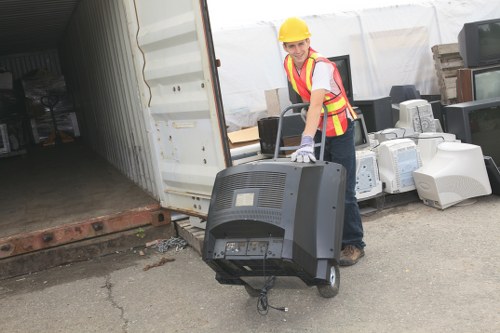
Operational controls include safe vehicles and load securing, clear walkways, segregation of recyclable and hazardous materials at source, and methods to reduce manual handling exposures. Where mechanical aids or two-person lifts are required, they must be used. For bulky items and appliances, mechanical lifting equipment or specialist teams are deployed to reduce injury risk during flat rubbish clearance operations.
Hazardous materials and special waste are handled according to statutory guidance. This includes safe identification, containment, and transfer of chemical containers, batteries, medical sharps and asbestos-suspect materials. Where asbestos is suspected, work is stopped and competent advice sought; only authorised personnel undertake work involving licensed asbestos removal. Contaminated items are treated as potentially infectious and handled with appropriate precautions during rubbish collection and waste removal activities.
 Emergency procedures are established for fire, injury, chemical spill or other incidents. First aid kits and trained first aiders are available at operational hubs and on larger projects. Incidents and near misses are reported immediately, investigated and lessons learned are shared to prevent recurrence. A documented accident reporting process supports statutory notifications and internal corrective actions.
 Monitoring, review and continuous improvement ensure the policy remains effective. Regular site inspections, safety audits, vehicle checks and review meetings identify performance gaps. A programme of periodic review updates risk assessments, procedures and training content to reflect changes in legislation, equipment or operational practice. Performance indicators cover incident frequency, training completion, and audit outcomes.
Contractors and Subcontracting: External contractors engaged for specialised clearance services must demonstrate their health and safety arrangements and evidence of competence. Coordination between organisations is required to manage shared risks and ensure that the standard of safety aligns with the primary policy.
Communication: This policy is communicated to all staff and relevant stakeholders. New employees receive an induction that explains safe working procedures for flat clearance, rubbish removal and related activities. Operational managers provide updates and maintain open channels for reporting safety concerns.
Commitment: The company will allocate sufficient resources to implement this policy effectively. Senior management endorses the policy and will review its effectiveness annually or following significant incidents or changes to operations. By adhering to the procedures set out here, the organisation seeks to deliver reliable, safe and compliant flat clearance and rubbish collection services across its service area while minimising risk to people and property.